
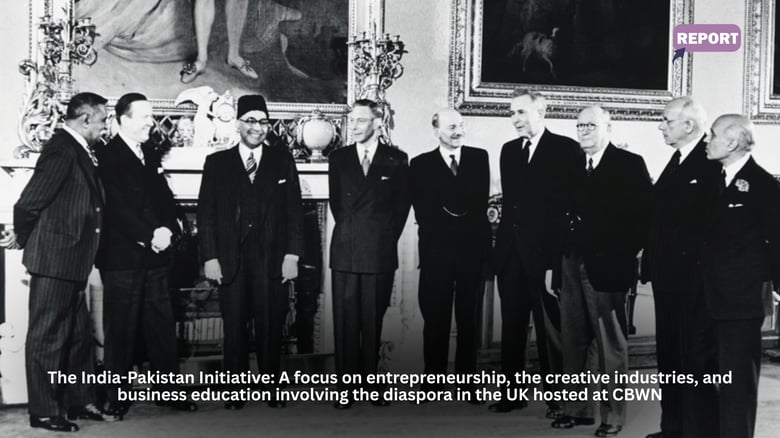
The India-Pakistan Initiative: A focus on entrepreneurship

The Prime Ministers of the UK (Clement Attlee), India (Jawaharlal Nehru) and Pakistan (Liaquat Ali Khan) with King George VI and other PMs at the 1949
Commonwealth Prime Ministers' Conference where they signed the London Declaration which said that republics and other countries could be part of the Commonwealth. The modern Commonwealth of Nations was born.
Purpose
Bridging people-to-people contacts and relationships between India and Pakistan with the diaspora in the UK playing a key role in the development of positive bilateral relationships in the following areas:
* Arts and Creative Industries (including CreaTech)
* Trade, entrepreneurs and entrepreneurship ecosystems
* Higher Education especially business education
Benefits of deploying such an initiative from the United Kingdom
This approach, never tried in this way before, allows a step back from regional politics, creating a more neutral and less emotive route towards developing the bilateral relationship. Additional synergies can potentially be tapped and leveraged to support momentum from regular Commonwealth meetings and developments involving governments, the private sector and including Commonwealth Accredited Organisations.
Background
Not for the first time, in May 2025 while the world’s attention was elsewhere, a deteriorating, deleterious and destabilising political relationship between India and Pakistan spilled over into outright military conflict between two nuclear powers that have already been to war several times. While the conflict was short-lived, it coincided with other seemingly unrelated events in the UK which brought a spotlight to the power, promise and potential of South Asia including India and Pakistan.
These included a major exhibition at the SOAS Gallery in London (which closed on 21 June) on ‘(Un)Layering the Future Past of South Asia: Young Artists’ Voices’ with curators from Pakistan and India which showcased works by 26 young artists from India, Pakistan, Bangladesh, Sri Lanka, Nepal, and Afghanistan and served as a reflection of shared histories, artistic expression, and the aspiration for a more interconnected South Asia. On 10 June Bloomsbury Institute London hosted an event on ‘South Asia: people, promise and potential - art, film and discussion’ which highlighted the unfulfilled creative promise and potential of South Asia through art and film and the importance of Art, Identity, and Bridging Divides. On 11 June a special South Asia Peace Action Network (SAPAN) event took place in London on the role the diaspora can play in peacebuilding in South Asia. On 22 June, Salima Hashmi from Lahore delivered an impassioned lecture at the Scottish National Gallery on ‘the role of women in South Asian art.’
India and Pakistan were amongst eight countries - and the largest in terms of population - that founded the modern Commonwealth 76 years ago. Earlier in June, London Tech Week brought together large delegations from India and Pakistan and included a roundtable on synergies with the Commonwealth entrepreneur ecosystem involving the diaspora at Marlborough House, the Commonwealth Headquarters. At the end of June and against a challenging international context, Trade Ministers from the UK, India and Pakistan joined many others from across the Commonwealth in Namibia in a bold affirmation of their shared commitment to deepen intra-Commonwealth trade, unlock sustainable investment, and defend the integrity of the multilateral trading system. This itself came just after the UK and India concluded a Free Trade Agreement on 6 May after three years of negotiations.
This backdrop provided the impetus, incentive and inspiration for the Commonwealth Businesswomen’s Network (CBWN), an accredited Commonwealth organisation directly recognised by 56 governments - and involved in all these events - to instigate an initiative on India and Pakistan working with a leading Scottish entrepreneur of Indian origin. Aligned with Commonwealth Secretary-General Shirley Botchwey’s vision for "Trade, investment and economic resilience" and "transformation built from the ground up," and reinforced by the UK Government’s Modern Industrial Strategy, also launched in June, the plan focuses on three key areas: entrepreneurship, creative industries, and business education.
Two roundtables – the first in Edinburgh during the Edinburgh Festival in August and the second in London in September – will aim to bring several key stakeholders together to share and set out the vision and plan and invite collaboration in this timely future-focussed initiative.
Arif Zaman, Executive Director (Co-Chair, The India-Pakistan Initiative)
Veenu Sharma, Adviser, Diaspora Entrepreneurship (Co-Chair, The India-Pakistan Initiative)
